Showing posts with label compliance. Show all posts

Sunday, May 31, 2009

Cyberspace Security Review

On Friday (May 29, 2009) President Obama announced the nation’s plan to defend against attacks on the nation's computer networks; a “strategic national asset.” This plan includes appointing a Cyber-Security Chief, whom he has not yet chosen, in the White House. Obama will sign a classified order within the coming weeks that will create the military cybercommand.

He stated that cyber-criminals have cost US citizens over $8 billion worth of stolen data and that the figure worldwide was up to $1 trillion.

The announcement came with the release of the Cyberspace Security Review, a 76 page document that had 60-days to be completed from the date of the initial request. The Cyberspace Security Review explains how the US intends to secure its critical network infrastructure. It was stated that the review was necessary because, “America's failure to protect cyberspace is one of the most urgent national security problems facing the new administration”, and that, “our digital infrastructure has already suffered intrusions that have allowed criminals to steal hundreds of millions of dollars and nation-states and other entities to steal intellectual property and sensitive military information.”

The Cyberspace Security Review made the following 10 recommendations for near-term action:

  1. Appoint a cybersecurity policy official responsible for coordinating the Nation’s cybersecurity policies and activities; establish a strong NSC directorate, under the direction of the cybersecurity policy official dual-hatted to the NSC and the NEC, to coordinate interagency development of cybersecurity-related strategy and policy.
  2. Prepare for the President’s approval an updated national strategy to secure the information and communications infrastructure. This strategy should include continued evaluation of CNCI activities and, where appropriate, build on its successes.
  3. Designate cybersecurity as one of the President’s key management priorities and establish performance metrics.
  4. Designate a privacy and civil liberties official to the NSC cybersecurity directorate.
  5. Convene appropriate interagency mechanisms to conduct interagency-cleared legal analyses of priority cybersecurity-related issues identified during the policy-development process and formulate coherent unified policy guidance that clarifies roles, responsibilities, and the application of agency authorities for cybersecurity-related activities across the Federal government.
  6. Initiate a national public awareness and education campaign to promote cybersecurity.
  7. Develop U.S. Government positions for an international cybersecurity policy framework and strengthen our international partnerships to create initiatives that address the full range of activities, policies, and opportunities associated with cybersecurity.
  8. Prepare a cybersecurity incident response plan; initiate a dialog to enhance public-private partnerships with an eye toward streamlining, aligning, and providing resources to optimize their contribution and engagement.
  9. In collaboration with other EOP entities, develop a framework for research and development strategies that focus on game-changing technologies that have the potential to enhance the security, reliability, resilience, and trustworthiness of digital infrastructure; provide the research community access to event data to facilitate developing tools, testing theories, and identifying workable solutions.
  10. Build a cybersecurity-based identity management vision and strategy that addresses privacy and civil liberties interests, leveraging privacy-enhancing technologies for the Nation.

What is promising about the Review is that there's repeated focus on outcomes as opposed to the inputs. Too often forward progress is hindered by the inefficient efforts of trying to define process before goals and objectives are clearly defined and understood. Rather, the Review consistently attempts to make it clear what the strategic outcomes are, and from those objectives, the development of process will be guided.

The Review also states, “Other structures will be needed to help ensure that civil liberties and privacy rights are protected.” The inclusion to help protect our privacy and civil liberties is an indication of the balanced intention of the plan.

Money will also be set aside for research and development of security technologies, from which there will be significant opportunity.

What I'm not certain about is the overall effectiveness the Cyber-Security Chief will have. Specifically, the position will not have direct access to the president. As a result, this position may not be high-level enough to prevent the almost certain bureaucratic nonsense, internal bickering and games that could waste millions/billions of dollars.

Though the Review solely focusses on defensive measures, I'm also curious what efforts are underway, if any, towards the development and potential use of cyberweapons.

Overall, the document doesn't suggest that there will be any major changes that will affect the private sector within the near term. The Review recommends specific changes to the direction of future US policies. Within the mid-term I imagine that lawmakers will develop regulations that will require the sharing of security incident data from the private sector with the government, presumably tempered with the commitment to ensure civil liberties. I anticipate that we will also see more emphasis put towards penetration testing and incident response.

Steve

###

Saturday, February 7, 2009

Thoughts on IT Security Organizational Structure

I've recently been asking myself how to most effectively structure Information Security (InfoSec) within an organization. Here are some thoughts I've had while trying to answer this.

As with any "structure" there needs to be some form of integral support, whether it's a frame for a house or honeycomb for a beehive. This is also true with organizational structures - there needs to be support. In order for InfoSec to be successful it must have the full support of senior or executive management. This support would be actualized as a sincere commitment by senior management to achieve the following:

  • Develop high standards of corporate governance
  • Treat InfoSec as a critical function that enables an organization to do business
  • Create an environment that understands the importance of, and embraces, InfoSec
  • Consistently show 3rd parties that InfoSec is vital and will always be handled in a professional manner
  • Ensure that controls being implemented by InfoSec are appropriate and proportionate to risk being addressed
  • Stay informed and accept ultimate responsibility and accountability

The first bulleted point in the above list, "Develop high standards of corporate governance", is where the necessary framework is built from which InfoSec can flourish. At a minimum, an effective governance framework includes:

  • An all-inclusive security strategy that links to clearly defined and documented business objectives
  • Security policies that address the multiple facets of security strategy, regulatory compliance and controls
  • Standards for each of the policies to make sure that procedures and guidelines comply with policy
  • An organizational structure void of conflicts of interest with sufficient resources and authority
  • Metrics and monitoring processes to ensure compliance and provide feedback

Again, I want to emphasize that It is imperative that an organization's top management sees InfoSec as a critical business function and is fully committed to stand behind InfoSec. Without the complete assurance from top management we will continue to see security functions getting moved around the organization while adequate resources are never obtained and conflicts of interest are progressively created.

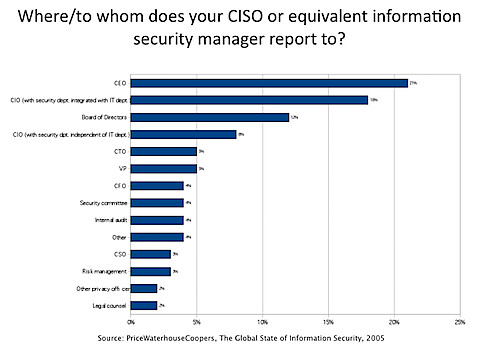
To limit conflicts of interest and actualize the benefits from investing within InfoSec, the Chief Information Security Officer (CISO/ISO) or Information Security Manager (ISM) must report directly to the top of the organizational structure, or an independent branch such as Audit. The trend in the past was to embed central InfoSec within Information Technology (IT), that is, until organizations began realizing that this structure kept InfoSec's hands tied behind their back, significantly reducing InfoSec's overall effectiveness. In other words, organizations were self-limiting their return on investment (ROI) from InfoSec. To resolve this issue and improve the ROI from InfoSec, CISO's/ISO's/ISM's began reporting to the CEO's, CFO's, CTO's and CIO's.

Slide11.png

Ok, great, so the ISO should report to the CFO ... then what?

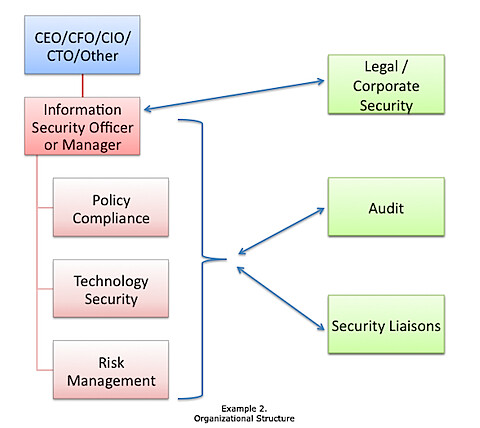
What we want to avoid is a structure with the fragmentation that is commonly seen today. Rather, create a tighter integration of the duties and activities performed by IT Security, Operations, Policy & Compliance, Risk Management and Audit. To anticipate the trends of the future, it’s very likely that individuals and departments taking on central InfoSec duties will also have various risk management responsibilities that extend beyond IT. This can include anything from physical security, business continuity and disaster recovery.

Slide1.png

Fact is, too often in industry the security discipline is (mis)directed by technology instead of using a risk analysis and proactive ‘intelligence’ approach. To add to the vicious cycle, when majority of the investment is being put into technology then most of the return comes from there too. This reinforcement perpetuates the destructive spiral.

So, how does a business avoid this technodazed shortsightedness? It comes down to strategy, making the conscious shift to be more strategic. This means moving away from the predictable technology-centric and tactical security operation seen in the industry since the golden days of the dot-gone era. At a high level, for InfoSec to more closely align with and help business achieve its objectives, InfoSec will need to become more focussed on 'intelligence'; gathering information, ability to comprehend, ability to develop policy and plans at a high level, using a methodology of risk analysis and risk mitigation, having the knowledge about an organization's business environment that has implications for its long-term viability and success, thinking long-term, and being both pragmatic and visionary.

Thinking strategically while taking into account anticipation of future trends and using proactive 'intelligence', I believe the wise CISO, or equivalent, who's in a healthy organizational environment needs to start planning for incorporating some of the non-IT specific risk management responsibilities before it's thrust upon them within the next three to five years. There will need to be coordination between IT Security, Operations, Policy & Compliance, Risk Management, Audit and Physical Security.

What this boils down to is that a very effective way to structure InfoSec within an organization involves having the CISO, or equivalent, reporting directly to the senior/executive level of the organization while having their full support, commitment and involvement. This top level commitment includes the development of high standards of corporate governance and actively limiting conflicts of interest so that InfoSec will be effective and provide a high ROI by enabling the organization to do business.

Slide2.png
Steve
###

Monday, June 9, 2008

PCI Security Standards Council Mandates New Vulnerability Scoring

I recently learned that all Approved Scanning Vendors (ASVs) are required to use version 2 of the Common Vulnerability Scoring System (CVSS). Starting July 1, 2008, version 2 will be the new industry standard and all scans will be scored using this system.

Many of the ASVs that I have experience with continue to fail scans based upon false positives. Although PCI DSS requirement 11.3.1 necessitates a network-layer penetration test to be performed at least once a year and after any significant infrastructure upgrade or modification, the automated quarterly vulnerability scans will still show a compliance failure even if the flagged vulnerability is a false positive.

It'll be interesting to see how many merchants will move from compliance status of compliant to non-compliant after July 1.